
Exploring the world of crossword puzzles often involves identifying a “receiver of instruction‚” a term frequently represented by words like “pupil” or “student.”
Gestures‚ like mimicking bike riding‚ aid understanding‚ while future tech—laptops—may personalize learning for each pupil‚ impacting clue creation and solving.
Understanding the Core Concept
The essence of a “receiver of instruction” clue lies in recognizing someone actively engaged in learning. This individual‚ whether a “pupil” or “student‚” absorbs knowledge presented by an educator.
Consider how a teacher might use gestures – like simulating bike riding – to clarify a concept for a pupil. This highlights the dynamic between instructor and learner.
Furthermore‚ the increasing potential for personalized learning‚ potentially through laptops for each student‚ suggests a future where instruction adapts to individual needs‚ influencing both clue creation and solution approaches within crossword puzzles.
The Role of a “Receiver of Instruction”
A “receiver of instruction” isn’t merely a passive recipient; they actively participate in the learning process. This role demands engagement‚ questioning‚ and the ability to interpret guidance‚ even when conveyed through non-verbal cues like gestures.
Students‚ as receivers‚ may face challenges – like those related to visual deficits impacting reading – requiring tailored support.
Looking ahead‚ the integration of technology‚ such as laptops‚ could empower pupils with personalized learning experiences‚ shifting the receiver’s role towards greater self-direction and independent exploration.

Common Answers & Variations
Frequently‚ crossword clues for “receiver of instruction” yield answers like “pupil” or “student.” However‚ “learner” emphasizes the active process of acquiring knowledge and skills.
Pupil as the Primary Solution
Historically‚ “pupil” stands as a cornerstone answer when encountering a “receiver of instruction” crossword clue. The provided context illustrates a teacher utilizing gestures – specifically‚ mimicking bike riding – to facilitate a pupil’s comprehension. This highlights the traditional teacher-pupil dynamic often evoked by the term.
Furthermore‚ the concept of a pupil readily aligns with classroom settings and educational environments‚ making it a highly probable solution for crossword enthusiasts. Its simplicity and direct association with learning contribute to its prevalence in puzzle construction.
Student: A Frequent Synonym
Alongside “pupil‚” “student” consistently emerges as a frequent and acceptable synonym for a “receiver of instruction” within crossword puzzles. This interchangeability stems from the overlapping meanings – both terms denote an individual actively engaged in the learning process.
The provided materials suggest a future where students may utilize laptops for personalized learning‚ subtly reinforcing “student” as a modern equivalent. Crossword creators often leverage this synonym to offer variety and challenge solvers‚ ensuring puzzles aren’t overly repetitive.
Learner: Emphasizing the Process
The term “learner” distinguishes itself as a “receiver of instruction” clue by highlighting the process of acquiring knowledge‚ rather than simply the role or status of the individual. This nuance can be particularly useful in crossword construction‚ allowing for more descriptive and evocative clues.
Considering cognitive processes in learning‚ “learner” subtly acknowledges the active engagement required‚ aligning with educational goals. Future trends‚ like personalized instruction‚ further emphasize this dynamic process‚ making “learner” a relevant and insightful synonym.

Crossword Clue Types & Strategies
Effective clues for “receiver of instruction” range from direct definitions to synonym-based prompts and contextual wordplay‚ often requiring solvers to think creatively.
Direct Definition Clues
Direct definition clues for “receiver of instruction” are the most straightforward‚ explicitly defining the answer. Examples include “One who learns‚” or “Student‚ for instance.” These clues rely on a solver’s foundational vocabulary and understanding of educational roles.
However‚ even direct clues can have slight variations in wording to increase challenge. A clue might be phrased as “One taking lessons” or “Person being taught‚” still pointing directly to terms like ‘pupil’ or ‘learner.’ The key is a clear‚ unambiguous connection between the clue and the answer.
Synonym-Based Clues
Synonym-based clues for “receiver of instruction” leverage words with similar meanings‚ adding a layer of indirection. Instead of directly defining the term‚ clues might use “Scholar‚” “Trainee‚” or “Disciple.” These require solvers to think beyond the most obvious answer and consider related concepts.
Effective synonym clues often hint at the context of learning. For example‚ “One attending classes” or “Person studying for exams” subtly guide the solver towards ‘student’ or ‘pupil.’ The challenge lies in recognizing the synonymous relationship and applying it to the crossword grid.
Contextual Clues & Wordplay
Contextual clues relating to a “receiver of instruction” often involve school settings or learning activities. A clue like “One who does homework” or “Subject of a teacher’s guidance” indirectly points to the answer. These clues rely on understanding the typical environment where instruction occurs.
Wordplay‚ such as hidden word puzzles or anagrams‚ can also be employed. A clue might describe a profession needing instruction‚ prompting solvers to deduce the “receiver.” Creating crosswords involves eliciting answers and crafting clues‚ demanding both knowledge and creativity.

Educational Context & Crossword Puzzles
Crosswords enhance classroom learning by developing question-writing skills and enabling a “reverse approach”—using answers as clues‚ fostering deeper understanding of instruction.
Crosswords in the Classroom
Integrating crossword puzzles into educational settings offers a dynamic way to reinforce learning‚ particularly when focusing on terms like “receiver of instruction.” Students actively engage with vocabulary and concepts‚ solidifying their understanding through problem-solving.
Activities can involve students creating clues based on answers – a “reverse approach” – promoting critical thinking and a deeper grasp of the material. Teachers can also utilize crosswords to assess comprehension‚ identifying areas where pupils might need additional support.
Furthermore‚ collaborative crossword creation encourages teamwork and communication skills‚ while the puzzle format itself can be adapted to various subjects and age groups‚ making it a versatile educational tool.
Developing Question-Writing Skills
Crafting effective crossword clues‚ especially those targeting a “receiver of instruction‚” demands precise language and a nuanced understanding of definitions. Students learn to rephrase concepts into indirect questions‚ fostering analytical thinking and vocabulary expansion.
The process of transforming an answer – like “pupil” or “student” – into a compelling clue necessitates considering synonyms‚ context‚ and potential wordplay. This exercise strengthens their ability to communicate ideas clearly and concisely.
Moreover‚ analyzing existing clues helps students discern different clueing techniques‚ improving their own question-writing proficiency and overall language skills.
Using Answers as Clues – A Reverse Approach
A unique pedagogical technique involves presenting students with the answer – “pupil‚” “student‚” or “learner” – and challenging them to formulate the corresponding crossword clue. This “reverse engineering” process deepens their comprehension of clue construction.
By starting with the solution‚ students must actively consider various definitions‚ synonyms‚ and contextual hints that could lead a solver to the correct answer. This reinforces their understanding of how clues function.
This method also encourages creative thinking and problem-solving skills‚ as they explore multiple possibilities for crafting an effective and engaging clue.

The Science of Learning & Instruction
Cognitive processes are key; attention and focus impact how a “receiver of instruction” – a pupil – absorbs information‚ potentially aided by nootropic drugs.
Cognitive Processes in Receiving Instruction
Understanding how a “receiver of instruction‚” like a pupil‚ processes information is crucial. This involves attention‚ memory‚ and comprehension‚ all interconnected cognitive functions. Nootropics aim to enhance these processes‚ potentially boosting focus and learning capacity.
However‚ effective instruction also relies on clear communication and contextual clues. A teacher’s gestures‚ such as demonstrating bike riding‚ aid understanding by linking abstract concepts to concrete experiences. Dyslexia can disrupt these processes‚ highlighting visual deficits and impacting eye movements during reading‚ ultimately affecting the receiver’s ability to decode clues;
The Impact of Gestures on Understanding
Gestures significantly enhance a “receiver of instruction’s” comprehension‚ bridging the gap between abstract concepts and concrete understanding. A teacher mimicking bike riding‚ for example‚ provides a visual cue aiding a pupil in grasping the question’s intent.
This kinesthetic element reinforces learning‚ particularly beneficial for those facing learning challenges like dyslexia‚ where visual processing can be impaired. Effective instruction leverages such non-verbal communication‚ supplementing traditional methods and improving the receiver’s ability to decode clues and retain information.
Attention & Focus in Learning
Maintaining attention and focus is crucial for any “receiver of instruction‚” directly impacting their ability to decipher crossword clues and absorb information. The allure of nootropics—cognitive enhancers—highlights the desire to boost concentration and memory.
However‚ optimizing focus often involves simpler strategies. Clear communication‚ engaging teaching methods‚ and minimizing distractions are paramount. Future technologies‚ like personalized learning via laptops‚ aim to cater to individual attention spans‚ fostering a more effective learning environment for every pupil.
Pharmaceuticals & Cognitive Enhancement (Related to Focus)
Nootropics‚ or “smart drugs‚” are increasingly popular for memory improvement and enhanced focus‚ sometimes utilizing sublingual administration for faster absorption and heightened alertness.
Nootropics: A Brief Overview
Many individuals are drawn to nootropics – often called “smart drugs” or cognitive enhancers – with the aim of boosting memory‚ increasing mental activity‚ and improving overall concentration.
These substances are sought to provide a high dose of energy‚ extending wakefulness and activity levels‚ potentially aiding a “receiver of instruction” in absorbing and retaining information.
However‚ it’s crucial to understand that the efficacy and safety of nootropics vary significantly‚ and responsible usage‚ alongside traditional learning methods‚ is paramount.
Sublingual Drug Administration & Absorption
Administering medication under the tongue – sublingually – offers a faster and more efficient delivery system‚ allowing the drug to reach the bloodstream directly‚ bypassing digestive processes.
This method ensures a higher concentration of the substance reaches its target‚ potentially enhancing focus and cognitive function‚ which could benefit a “receiver of instruction” during learning.
Unlike oral administration‚ sublingual absorption avoids the harsh digestive environment‚ maximizing the drug’s potency and effectiveness.
Medications for Attention & Concentration
Nootropics‚ often called “smart drugs” or cognitive enhancers‚ are increasingly popular for their potential to improve memory‚ mental activity‚ and focus – crucial for any “receiver of instruction.”
These substances aim to boost alertness‚ enhance concentration‚ and provide sustained energy‚ potentially aiding learning and academic performance.
However‚ it’s vital to understand that such medications should be approached with caution and under proper medical guidance‚ considering individual needs and potential side effects.
Dyslexia & Learning Difficulties
Visual deficits and atypical eye movements can contribute to reading failures‚ potentially impacting a “receiver of instruction’s” ability to decode clues and solve puzzles.
Visual Deficits & Reading Failures
The connection between visual processing and reading proficiency is crucial for any “receiver of instruction.” Documents highlight how clue-based identification can reveal underlying learning challenges‚ specifically linking visual deficits to persistent dyslexia. These deficits impact a student’s ability to accurately perceive and process written information.
Consequently‚ decoding crossword clues—requiring precise visual discrimination—becomes significantly harder. Eye movement patterns differ in dyslexic readers‚ affecting their scanning and comprehension skills. Addressing these visual challenges is paramount for effective learning and successful puzzle-solving;
Eye Movements & Dyslexic Readers
Research indicates distinct differences in eye movement patterns between proficient readers and those with dyslexia‚ impacting their ability to function as a “receiver of instruction.” Dyslexic readers often exhibit erratic and less efficient eye movements when tackling tasks like solving crossword clues.
These patterns include increased fixations‚ regressions (re-reading)‚ and a narrower perceptual span. This impacts their ability to quickly scan and process visual information‚ hindering clue comprehension and answer retrieval. Understanding these patterns is vital for targeted interventions.
Clue-Based Identification of Learning Challenges
Crossword puzzles‚ designed to test a “receiver of instruction’s” comprehension‚ can inadvertently reveal underlying learning difficulties. Consistent struggles with specific clue types – synonym-based or contextual‚ for example – might signal weaknesses in vocabulary or inferential skills.
Observing a student’s approach to clues‚ noting frequent requests for assistance‚ or identifying patterns of misinterpretation can offer valuable insights. These observations‚ coupled with other assessments‚ can help pinpoint areas needing support and tailor instruction accordingly.
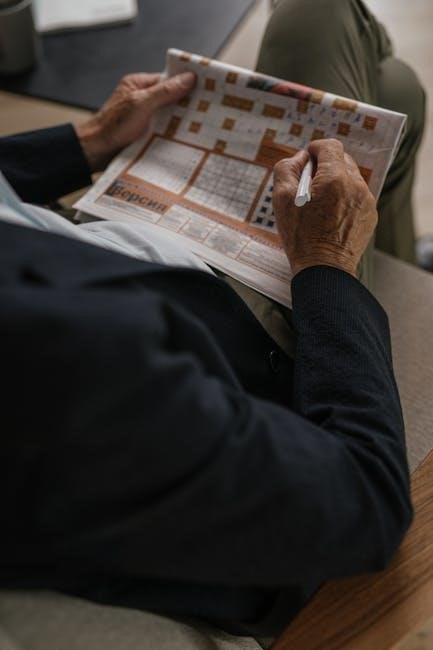
Crossword Puzzle Creation & Design
Designing effective crosswords involves crafting clues that test a “receiver of instruction’s” knowledge‚ while considering difficulty and the target audience’s comprehension level.
Students can create puzzles‚ using answers as clues‚ enhancing question-writing skills and reinforcing learning concepts.
Instructions for Creating Crosswords
Begin by selecting a central theme‚ potentially revolving around education and the “receiver of instruction.” Construct a grid‚ interweaving words related to learning – pupil‚ student‚ learner – ensuring sufficient intersecting letters for challenge.
Next‚ formulate clues. Consider direct definitions (“a person being taught”) or synonym-based prompts. Encourage students to write questions using the answer as the clue‚ fostering deeper understanding.
Remember to vary clue difficulty‚ catering to different skill levels. A hidden job clue‚ where answers reveal a profession‚ adds complexity. Always develop a comprehensive answer key for verification and self-assessment.
Answer Key Development
A meticulous answer key is crucial for crossword puzzle success. List each clue number alongside its corresponding solution‚ ensuring accuracy – for example‚ “1. Pupil.” Verify all answers fit seamlessly within the grid‚ confirming letter intersections are correct.
Include alternative valid answers if applicable‚ acknowledging potential synonyms for “receiver of instruction” like “student” or “learner.”
Consider adding brief explanations for clues employing wordplay or contextual hints‚ aiding solvers. This key serves as a definitive guide‚ facilitating self-checking and resolving disputes.
Clue Difficulty & Target Audience
Tailoring clue difficulty to the intended audience is paramount. For younger learners‚ direct definitions – “One who learns” – are ideal. More experienced solvers appreciate synonym-based clues or those requiring contextual understanding.
Consider incorporating wordplay‚ but avoid excessive obscurity for beginners. A puzzle designed for classroom use should align with the students’ current vocabulary and knowledge base.
Balance challenge with accessibility‚ ensuring solvers feel engaged without becoming frustrated when seeking the “receiver of instruction.”
Specific Examples from Online Resources
Online resources showcase clues like defining professions‚ crafting questions from answers‚ and referencing school life – homework or authority figures – for “receiver of instruction.”
Example Clues Related to Professions
Consider clues designed around professions‚ subtly hinting at those who receive instruction. For instance‚ “One who learns from a doctor (6)” could lead to ‘patient’. Or‚ “Student of law (6)” points to ‘pupil’.
Another example: “Artist’s student (6)” yields ‘learner’. These clues cleverly utilize the profession to define the “receiver of instruction” indirectly.
Teachers might use these in class‚ having students guess the job and fill it into a crossword‚ fostering both vocabulary and problem-solving skills.
Examples of Questions Based on Answers
To challenge students‚ reverse the process: provide the answer and ask them to formulate the clue. If the answer is “student‚” a question could be: “Who attends classes and learns from a teacher?”
Similarly‚ for “pupil‚” ask: “Who is taught by an educator?” This develops question-writing skills‚ forcing a deeper understanding of definitions.
Objective: enable pupils to write the question using the answer as the clue‚ reinforcing the connection between word and definition in a creative way.
Clues referencing Homework & School Authority
Crossword clues can cleverly incorporate school life. For example: “What’s often incomplete‚ leading to detention?” (Homework). Or‚ “Who might discuss a pupil’s lack of homework?” (Monitor/Headmaster).
These clues subtly link the “receiver of instruction” – the pupil – to common school scenarios‚ adding a relatable layer to the puzzle.
Such questions test not just vocabulary‚ but also understanding of the school environment and authority figures impacting the learning process.
Advanced Clue Techniques
Beyond simple definitions‚ advanced clues employ anagrams‚ hidden words‚ and even cryptic wordplay to challenge solvers‚ subtly referencing the “receiver of instruction.”
Hidden Word Clues
Hidden word clues cleverly embed the answer within the clue’s text itself‚ demanding careful reading and pattern recognition from the solver. These clues don’t directly define; instead‚ they require extracting letters sequentially from the wording.
For a “receiver of instruction” like ‘student’‚ a clue might read: “Studying together understands daily exercises‚ naturally thriving.” The bolded letters reveal the hidden answer. This technique adds a layer of complexity‚ moving beyond straightforward definitions and testing observational skills.
Creating such clues necessitates precise wording and a thorough understanding of the target answer‚ ensuring seamless integration without obvious giveaways.
Anagram Clues
Anagram clues present a jumbled rearrangement of the letters forming the answer‚ challenging solvers to unscramble them. For “receiver of instruction” answers like ‘pupil’ or ‘student’‚ this technique offers a playful twist.
An example clue might be: “Listen‚ rearranged!” (for ‘student’) or “Lupi‚ mixed up!” (for ‘pupil’). The solver must recognize the anagram and reconstruct the correct word. This relies on letter frequency knowledge and pattern recognition skills.
Effective anagram clues avoid overly common letter combinations‚ increasing difficulty and rewarding successful decryption with a satisfying “aha!” moment.
Cryptic Clues (Brief Mention)
Cryptic clues‚ a hallmark of British-style crosswords‚ employ layers of wordplay‚ misdirection‚ and hidden meanings – a significant leap in complexity. While less common for straightforward “receiver of instruction” terms‚ they can appear.
A cryptic clue might indirectly hint at a pupil or student through a definition combined with an anagram or hidden word. Deciphering requires understanding cryptic conventions‚ like indicators for anagrams (“mixed‚” “broken”) or reversals (“backwards”).
These clues demand lateral thinking and a broad vocabulary‚ moving beyond simple synonym recognition to a more puzzle-solving approach.

Future Trends in Education & Technology
Personalized learning‚ potentially via laptops for each pupil‚ will reshape instruction and‚ consequently‚ the types of clues—and answers—featured in crossword puzzles.
The Potential of Laptops for Students
The increasing possibility of each pupil having a dedicated laptop represents a significant shift in educational delivery; This technology facilitates personalized learning experiences‚ tailoring instruction to individual needs and paces; Consequently‚ crossword puzzles‚ as educational tools‚ could evolve.
Clues might become more dynamic‚ referencing digital resources or specific software used in lessons. The very definition of a “receiver of instruction” could broaden‚ encompassing digitally engaged learners. Furthermore‚ laptops empower students to create their own puzzles‚ fostering question-writing skills and a deeper understanding of the learning process.
Personalized Learning & Instruction
Tailoring educational approaches to individual student needs profoundly impacts how we define a “receiver of instruction.” Personalized learning moves beyond a one-size-fits-all model‚ acknowledging diverse learning styles and paces. This shift influences crossword puzzle design‚ potentially leading to clues that reflect specific student interests.
Clues could be crafted around a pupil’s demonstrated strengths or areas needing improvement‚ making the puzzle a diagnostic and reinforcing tool. The concept of a learner‚ actively engaged in a customized curriculum‚ becomes central‚ enriching the puzzle’s educational value.

Resources for Crossword Solvers & Creators
Online websites and dictionaries offer valuable assistance for both solving and constructing puzzles‚ aiding in finding synonyms for “receiver of instruction” and crafting clever clues.
Online Crossword Puzzle Websites
Numerous websites cater to crossword enthusiasts‚ providing a diverse range of puzzles and tools. These platforms often feature searchable databases allowing solvers to explore clues related to “receiver of instruction” and potential answers like “pupil” or “student.”
Many sites offer interactive solving experiences‚ hint systems‚ and even the ability to create personalized puzzles. Resources can assist in understanding clue types‚ from direct definitions to more complex wordplay. Some platforms also provide access to historical puzzles and clue archives‚ aiding in research and inspiration for puzzle creators seeking varied approaches to this common theme.
Crossword Dictionary & Thesaurus
Essential tools for both solvers and constructors‚ crossword dictionaries and thesauruses unlock a wealth of possibilities when tackling clues like those for a “receiver of instruction.” These resources go beyond simple definitions‚ offering synonyms‚ related terms‚ and alternative phrasing crucial for crafting clever and challenging clues.
They aid in identifying potential answers – beyond “pupil” or “student” – and exploring nuanced wordplay. A thesaurus helps brainstorm variations‚ while a dictionary confirms accuracy and explores less common usages‚ vital for creating unique and engaging crossword experiences.
Understanding the “receiver of instruction” highlights learning’s core—clear communication. From classroom exercises to puzzles‚ effective instruction‚ and focused attention are key.
Recap of Key Concepts
Throughout this exploration‚ we’ve seen how “receiver of instruction” manifests in crossword puzzles‚ primarily as “pupil” or “student.” The process isn’t merely about answers; it’s about understanding how learning occurs.
Gestures‚ like demonstrating actions‚ significantly aid comprehension‚ while emerging technologies—specifically laptops—promise personalized learning experiences. Furthermore‚ attention and focus‚ sometimes aided by nootropics or sublingual medications‚ are crucial.
Addressing learning difficulties‚ like dyslexia‚ requires recognizing visual deficits and eye movement patterns. Ultimately‚ crafting effective clues and puzzles reinforces both instruction and the ability to decipher information.
The Importance of Clear Communication in Learning
Effective learning hinges on clear communication‚ mirrored in well-crafted crossword clues. A “receiver of instruction‚” be it a pupil or student‚ thrives when information is presented accessibly‚ aided by techniques like illustrative gestures.
Consider how a teacher’s demonstration—mimicking riding a bike—enhances understanding. Similarly‚ puzzle creation demands precise wording‚ while addressing learning challenges like dyslexia necessitates recognizing communication barriers.
Future advancements‚ including personalized learning via laptops‚ will further emphasize tailored communication strategies‚ ensuring every receiver of instruction can successfully decode and internalize knowledge.